
Five Main Stages of Biofilm Formation
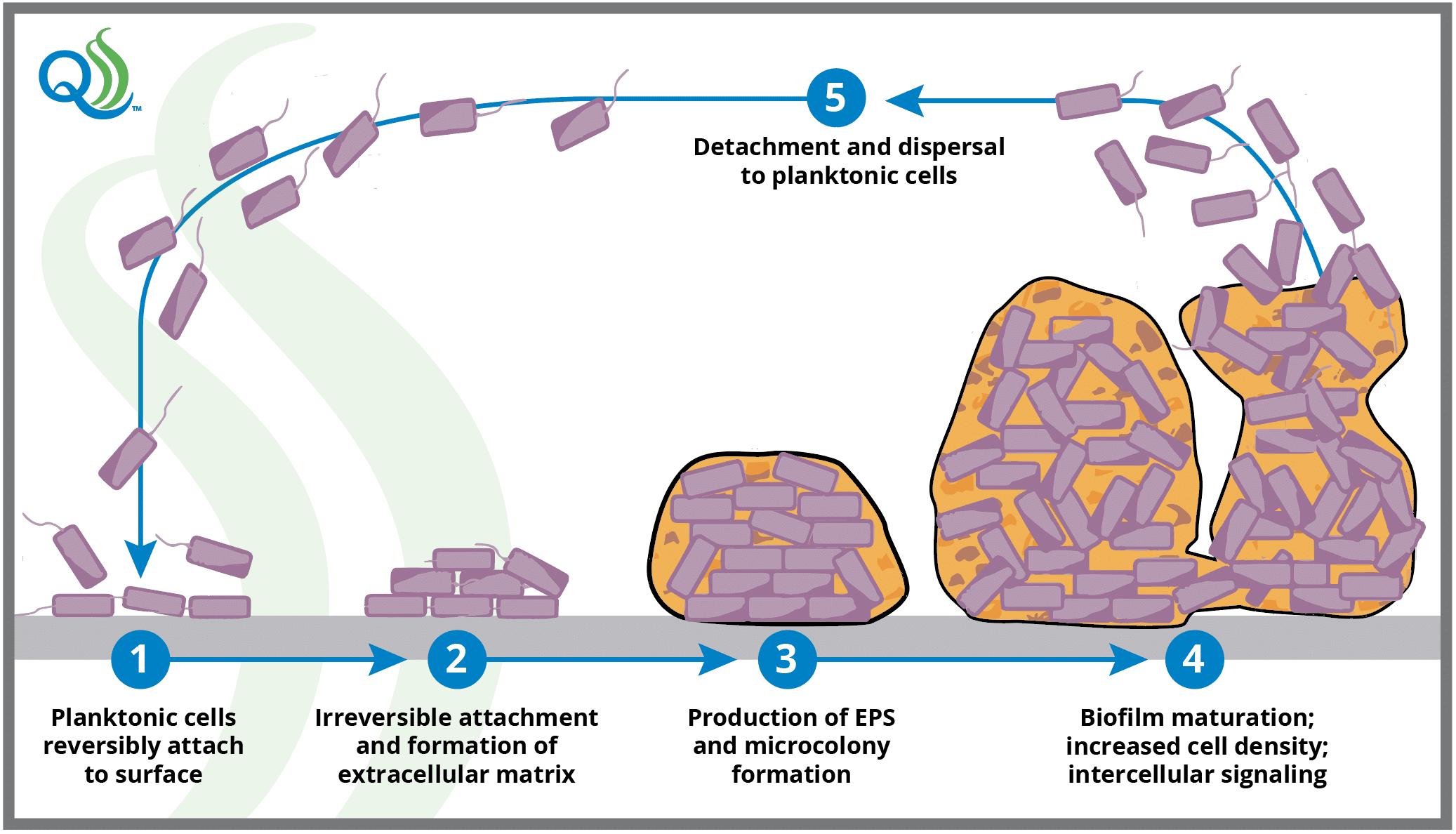
Biofilms form through five main stages, beginning when free-floating planktonic cells attach to a surface and ending when cells disperse to colonize new areas.
- Reversible attachment: Planktonic cells adhere weakly and non-specifically to a surface and may still detach.
- Irreversible attachment: Bacterial structures such as pili or fimbriae create stronger attachments to the surface.
- EPS production: Cells produce extracellular polymeric substances that help anchor and protect the developing biofilm.
- Biofilm maturation: Cell density increases, the biofilm becomes more structured, and signaling molecules allow cells to communicate.
- Dispersal or detachment: Cells leave the mature biofilm and return to a planktonic state, where they may attach elsewhere.
For a deeper look at how biofilms form, persist, and communicate, explore our white papers:
- Biofilms: A Persistent Challenge to the Dairy Industry
- Silent Signals: How Bacterial Communication Shapes Biofilms
- Biofilm Attachment: Surface-Dependent Mechanisms of Biofilm Attachment
Investigating Recurring Microbial Findings?
Biofilms can intermittently release microorganisms into the product stream, making contamination patterns difficult to identify. Proactive Biofilm Surveillance™ uses representative in-process sampling at strategic locations to help food safety and quality teams investigate recurring microbial findings, identify potential contamination patterns, and make more informed decisions about where to focus corrective actions.