Water: Your Most Used Ingredient—and Biggest Hidden Risk
Water quality monitoring is essential to product safety, shelf life, and operational efficiency. Water touches every part of your process. From cleaning systems to product formulation, it is both a vital ingredient and a hidden risk. Despite its importance, many facilities rely on water sampling strategies that fail to capture real-time water quality, leaving room for microbial intrusion, system failures, and regulatory noncompliance. Aseptic inline sampling offers a proactive, proven solution for validating and testing water quality.
Why Water Quality Monitoring Matters Across the Plant
Whether used for cleaning-in-place (CIP), blending, cooling, or direct product contact, water can serve as both a carrier of contaminants and a blind spot in quality monitoring. If your only water testing occurs at the source—or worse, after product has been packaged—you are leaving quality to chance.
When recycled or cooling water comes into direct contact with equipment or other food contact surface, microbial contamination is a hazard to be considered. Without reliable, and regular, verification that such water is fit-for-purpose, water systems may contribute to spoilage, quality failures, or even recall events. A structured, plant-wide program complies with the Pasteurized Milk Ordinance (PMO) and Food Safety Modernization Act (FSMA), improves shelf life, reduces flavor defects, and helps assure satisfactory customer audits with defensible records.
Aseptic inline sampling provides visibility at the point of use, in the conditions that matter.
Producing products at the highest standard possible is our goal at Cold Spring Brewing Company. QualiTru sampling systems help ensure we meet that goal with accurate water tests and uncompromised water samples.
Mat Eischens, Process Control Supervisor at Cold Spring Brewing Company
The Value of Aseptic Inline Validation
Where traditional water sampling methods fall short:
- Grab samples are vulnerable to contamination and may not reflect system variability.
- Outlet testing can miss upstream or point-of-use (POU) issues entirely.
- Post-production results come too late to prevent loss and often lack the precision needed to isolate sources of contamination.
Why aseptic inline, closed-system sampling improves outcomes:
- Collects accurate samples directly from water lines, tanks, and CIP return loops without interrupting production.
- Pinpoints problems by sampling upstream and downstream of reverse osmosis (RO) and ultraviolet (UV), filters, valves, and the point of use.
- Generates audit-ready trends and location-specific records.
QualiTru TruStream® ports with pre-sterilized, closed-system septa reduce the risk of introducing contamination, resulting in real-time data you can trust. Sampling at multiple points in the process and collecting composite samples over time provide a clearer understanding of how water quality fluctuates under actual operating conditions.
Have questions about sampling for water quality?
Need a quote? We’ll respond to
your request quickly.
Looking for one of our global distribution partners near you?
When Water Fails, the System Fails
Inadequate water verification is both a quality assurance (QA) concern and a operational liability. Poor water quality introduces contaminants that can:
- Seed biofilms in equipment that are hard to detect and harder to eliminate.
- Lead to downstream contamination in blending, fermentation, or bottling.
- Trigger quality failures or regulatory noncompliance.
Aseptic inline sampling allows processors to identify issues early and track microbial or chemical trends over time. When used as part of a water management plan, aseptic inline water sampling becomes a frontline defense against contamination and costly surprises.
Build a Water Validation Plan (Regulatory Compliance Aligned)
- Map points of use: ingredient addition, pre/post RO or UV, CIP rinse outlets, plate coolers, fillers.
- Define indicators and methods: heterotrophic plate count (HPC), total coliforms/E. coli, targeted pathogens where required.
- Set frequency and triggers: baseline, routine verification, and event-based after maintenance or excursions.
- Trend and act: establish alert/action limits with linked corrective actions and re-verification.
- Document: log locations, dates, methods, results, actions, and sign-offs for audit readiness.
Reverse Osmosis, Ultraviolet, and Filtration Performance Monitoring
Validate barrier performance with pre- and post-unit sampling and at the nearest point of use. Use results to detect membrane fouling, UV lamp aging, and breakthrough. Include storage or recirculation loops where stagnation can occur.
Cleaning-in-Place and Rinse Validation
Pair CIP parameter checks with rinse-water sampling to confirm lines are clean, microbiologically acceptable, and allergen free before production resumes. Target pre-rinse, final rinse, and first-product interfaces to verify corrective cleaning cyles and corrective actions.
Industries and Use Cases
From dairy to biotech, our sampling systems are trusted in some of the most demanding production environments. QualiTru’s sampling systems are ideal for:
- Dairy processing. Sampling water used for cooling, CIP, or post-cleaning rinses to comply with the PMO standards.
- Beverage production. Monitoring rinse water, blending water, and filling operations.
- Breweries. Validating RO/UV systems performance and spotting line contamination.
- Biotech & nutraceuticals. Ensuring purified water meets stringent microbial and particulate limits.
With pre-sterilized septa and tamper-evident collection containers, QualiTru sampling products help ensure that your water sampling is representative, reliable, and audit-ready.
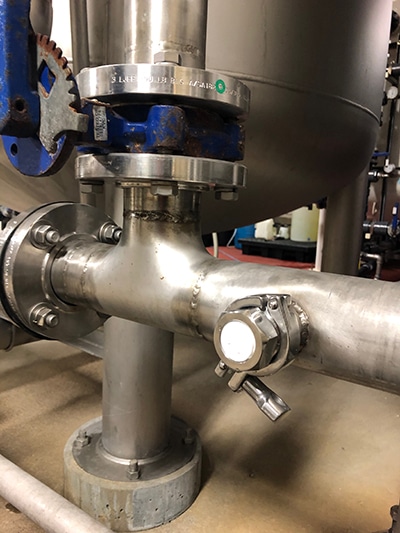
Sampling Spotlight: Inline water checks catch hidden microbial spikes
A beverage facility added closed-system aseptic sampling at multiple points in its water loop—pre/post RO and UV, at CIP return, and at filler points of use. Trending heterotrophic plate counts revealed intermittent spikes tied to stagnation after cleaning cycles. By adjusting recirculation and verifying with follow-up samples, the team stabilized the loop and reduced downstream quality variability. Read the full story: Water system testing for microorganisms.
Build Confidence into Every Drop
Water quality monitoring should not be an afterthought. It is an essential part of ensuring food safety, protecting brand reputation, and meeting the expectations of regulators and global customers.
Quick-Start Checklist
- Map POUs where water touches product or product-contact surfaces.
- Install closed-system ports pre/post barriers and at high-risk POUs.
- Trend HPC and indicators weekly by location with alert/action limits.
- Tie exceedances to defined corrective actions and re-verification.
- Reassess quarterly and after maintenance or system changes.
Talk to an Expert / Get a Quote
Complete this form to have one of our experts contact you to discuss transforming your water testing program from a lagging indicator to a proactive assurance tool! Or call us at (651) 501-2337 or email [email protected] to learn more.
We recommend the following QualiTru sampling products to support accurate, timely sampling for water quality monitoring, so teams can take action sooner to protect product safety and quality.
- Inline Sampling
- TruStream7 Tri-Clamp Tee 2” (Part #215147) or TruStream 7 Tri-Clamp Elbow 2″ (Part #213029)
- TruStream7 Septa (Part # 110011)
- TruStream 250ml/18g (Part #111450) or TruMotion 2L/18g w/2.0mm Tubing (Part #111770) with a Watson-Marlow Pump (Part #500000) for a representative sample or the TruDraw® Sterile Single Sampler (Part #112021) for a small, aseptic sample