
Dead Ends in Cheese Processing: Trapped Cheese Residues as a Driver of Defect Rates
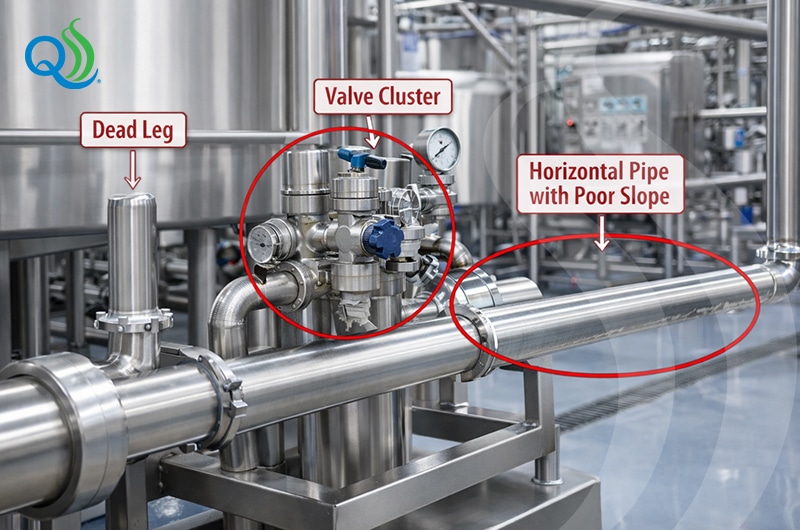
In the complex environment of cheese processing, optimization often focuses on visible control points: pasteurization temperatures, pH targets, culture activity, and packaging sterility. Yet lurking within the physical infrastructure of the plant are literal dead end slow-flow or blind areas that allow residues to accumulate. These dead ends, like valve clusters, stagnant flow zones, blind extensions, and legacy equipment designs, trap protein- and fat-rich residues that evade clean-in-place (CIP) systems. Even small hydraulic shadows in hygienic piping can harbor biofilms that survive routine cleaning.
These hidden pockets of trapped cheese residues are a persistent threat to product quality and consistency, acting as microbial harborage points that defy routine cleaning protocols and introduce spoilage organisms and defect-causing metabolites into an otherwise well-controlled system. Identifying, monitoring, and eliminating or modifying dead ends help reduce variability and protect quality.
What are dead ends in cheese processing and why do they trap residues?
Dead ends in cheesemaking systems can vary significantly in scale, from capped extensions of piping several inches long to microscopic crevices within valve seats or gaskets. According to 3-A Sanitary Standards, a dead end longer than two times the nominal diameter and no more than 5 inches is considered a hygienic design failure. However, even smaller imperfections, such as a misaligned valve diaphragm or an insufficiently sloped section of horizontal piping, can collect curd particles and moisture. These features often go unnoticed during standard visual inspections, particularly when hidden beneath insulation or embedded in legacy system configurations. For quality assurance (QA) and plant managers, identifying these harborage points demands detailed flow mapping, review of cleaning validation data, and targeted microbial sampling to trace contamination to its source.
The composition of cheese curd creates an ideal substrate for microbial growth. High in protein and fat, and retaining moisture, curd particles can lodge in stagnant zones and evade even aggressive CIP cycles. This is particularly problematic in systems that process high-moisture or high-fat cheeses, or those that operate extended runs without full disassembly. According to Sela et al. (2022), small product traps or “hydraulic shadows” within a system can lead to biofilm development even in hygienically designed piping.
Common Dead-End Risks in Cheese Lines
- Tri-clamp fittings or valve seats with incomplete drainability.
- Y-junctions or dead-leg extensions longer than two times the nominal pipe diameter.
- Horizontal pipelines with inadequate slope.
- Poorly designed curd tables or drainage screens.
- Equipment transitions, such as from curd knives to conveyors.
Once residues settle in these areas, microbial activity begins. Cheese curd particles, rich in proteins and fats, tend to adhere to rough or unpolished stainless steel surfaces, especially where fluid velocity drops below the threshold needed for self-cleaning. In these zones, flow stagnation allows particulates to settle and concentrate, creating microenvironments that are often anaerobic and shielded from cleaning solutions. Moisture and nutrient availability in these areas further support microbial colonization, particularly by psychrotrophic or anaerobic organisms well suited to low-oxygen, nutrient-dense conditions. Over time, microbial colonies develop into biofilms, gaining protection from mechanical removal and chemical sanitizers. While some contaminants may be benign, others produce gases (e.g., Clostridia), off-flavors (e.g., Pseudomonads), or proteolytic and lipolytic enzymes that degrade product quality over time (Gopal et al., 2015).
How dead ends in cheese processing contribute to biofilms and sloughing
Microbial harborage is not a new concept in dairy, but its impact in cheese production is both underappreciated and under-monitored. In complex matrixes like cheese, low-level contamination can take days or weeks to manifest. This is especially true in aged cheeses, where slow-growing psychrotrophs or anaerobes can alter flavor, texture, or appearance over time. Watch for gas-forming spoilage, pink discoloration, bitter flavors, premature aging, and open texture (“mechanical holes”) as harborage signals (Donnelly, 2022).
Even in short-aged or fresh cheeses, exposure to proteolytic bacteria from dead-end zones can lead to inconsistent texture or yield loss. “Cheesemakers often assume that when defect rates rise, they are due to starter culture variability or raw milk fluctuations,” notes Thompson and Hall (2021), “but a root cause analysis frequently uncovers post-pasteurization contamination from within the plant environment.”
Biofilm development exacerbates this risk. Mature biofilms are not only resistant to cleaning, but they also act as intermittent contamination sources. Sloughing events—when clusters of biofilms detach—can suddenly spike microbial loads downstream, contaminating an entire vat with a non-representative microflora (Kable et al., 2020). These events are particularly insidious because they are not predictable or evenly distributed.
Which cheese defects signal harborage problems?
Gas defects are a costly and visible consequence of microbial contamination. In Swiss-type cheeses, for example, improper gas production can result in slits, cracks, or late blowing due to unwanted Clostridia species. Unlike controlled eye formation from Propionibacterium freudenreichii, these anaerobes produce irregular and undesirable effects that compromise product quality. Similar issues arise in Gouda or Cheddar-style cheeses where inconsistencies in texture or flavor may be linked to residues harboring spoilage organisms.
While the specific source of contamination may vary from plant to plant, the underlying issue often stems from overlooked or poorly drained sections of the production line. These include blind extensions in piping, improperly sloped lines, or transitions between equipment types that were not accounted for during cleaning validation. The industry has come to recognize that even small design flaws can contribute to persistent, low-level contamination capable of undermining entire production lots.
How can in-process sampling verify control without downtime?
The challenge of identifying dead ends and their impact on product quality lies in their inaccessibility and intermittent shedding. Traditional surface swabbing or post-cleaning Adenosine Triphosphate (ATP) testing may not be capable of detecting the microbial load lurking within a blind pipe or under a valve seat. In-process sampling, however, offers a more proactive solution.
By installing aseptic sampling ports at key risk points—such as just downstream of pressing, at the outlet of curd tables, or near known dead-leg configurations—manufacturers can collect representative, real-time samples of process fluids (whey, curd wash, or milk) to monitor for microbial anomalies. This allows QA teams to detect early warning signs of harborage activity, such as elevated total plate counts, coliforms, or gas-forming organisms.
Sampling frequency and strategy are keys. Process sampling should not be limited to final product testing or regulatory checkpoints. Instead, it should be integrated into routine hygiene verification, allowing operators to assess the microbial load at different stages of production and link fluctuations to potential equipment-based harborage sites.
How-To Reduce Dead Ends in Cheese Processing Lines
Use these quick, practical steps to find residue harborage points and verify control without adding downtime.
Map likely dead ends. Walk the line with the schematic to flag blind extensions, low-slope horizontals, valve clusters, and non-flow-through tees.
Check hygienic-design basics. Keep dead legs at or below two times the nominal pipe diameter. Slope horizontal piping at least 1/8 inch per foot and prefer self-draining valves.
Place closed-system sample ports at risk nodes. To verify control in cheese processing operations, place ports just downstream of curd tables, near known dead legs, and after pressing to trend Aerobic Plate Counts (APC), coliforms, and spores.
Verify and trend. Run aseptic, in-process sampling during production; trend APC, coliforms, and spores to confirm control and catch drift early.
Correct and re-validate. Remove or shorten dead legs, adjust slopes, and replace problem fittings; repeat sampling to document improvement.
How do we design out the problem?
While in-process sampling can help identify contamination sources, long-term risk reduction requires careful engineering assessment. Hygienic design standards, such as those recommended by 3-A Sanitary Standards and the European Hygienic Engineering and Design Group (EHEDG), provide guidance on eliminating dead legs and ensuring full drainability. Equipment manufacturers are aware of these risks, but many older plants still operate with legacy systems not designed with modern cleanability in mind.
Key hygienic design principles that reduce harborage and support full drainage and flow:
- Avoiding dead legs exceeding two times the nominal pipe diameter.
- Sloping all horizontal lines at 1/8 inch per foot or more.
- Using self-draining valves and eliminating tee fittings without flow-through.
- Designing curd-handling systems to avoid flat zones and pooling.
Implementing these changes may require capital investment, but the cost is often outweighed by reduced rework, fewer product holds, improved shelf life, and enhanced brand protection.
From Findings to Fixes
Trapped cheese residues in dead ends are more than a cleaning nuisance—they are a systemic risk to product quality, consistency, and safety. These hard-to-clean zones harbor spoilage organisms and biofilms that intermittently seed the process stream, leading to batch variation and product defects.
For QA and plant managers committed to continuous improvement, recognizing the role of equipment design in microbial harborage is critical. In-process sampling enables early detection, but engineering controls are the long-term solution.
The payoff: fewer holds/reworks, longer shelf life, and more consistent flavor and texture.
Ready to reduce defects at the source? Contact us at (651) 501-2337 or email [email protected] and we’ll help identify high-risk dead ends and help set up an aseptic inline sampling plan to trend for APC, coliforms, and spores.
References:

Donnelly, C. W. (2022). Cheese and microbiological quality: A practical guide. American Dairy Science Association.

Gopal, N., Hill, C., Ross, P. R., Beresford, T. P., Fenelon, M. A., & Cotter, P. D. (2015). The prevalence and control of Clostridium and Pseudomonas species in the dairy processing environment. Frontiers in Microbiology, 6, 1-14. https://www.frontiersin.org/journals/microbiology/articles/10.3389/fmicb.2015.00577/full

Kable, M. E., Srisengfa, Y., Laird, M., Zaragoza, J., McLeod, J., Heidenreich, J., Marco, M. L. (2020). Microbial succession and flavor production in aged Cheddar cheese. mSystems, 5(5), e00534-20. https://journals.asm.org/doi/10.1128/msystems.00534-20

Sela, S., Amir, I., & Pinto, R. (2022). Biofilm formation and cleaning efficiency in dairy processing lines: Risks and control strategies. Journal of Dairy Science, 105(4), 3278-3290.

Thompson, B., & Hall, E. (2021). Undetected microbial harborage in cheesemaking: A root cause of rising defect rates. Dairy Plant Operations Journal, 18(2), 22-27.