
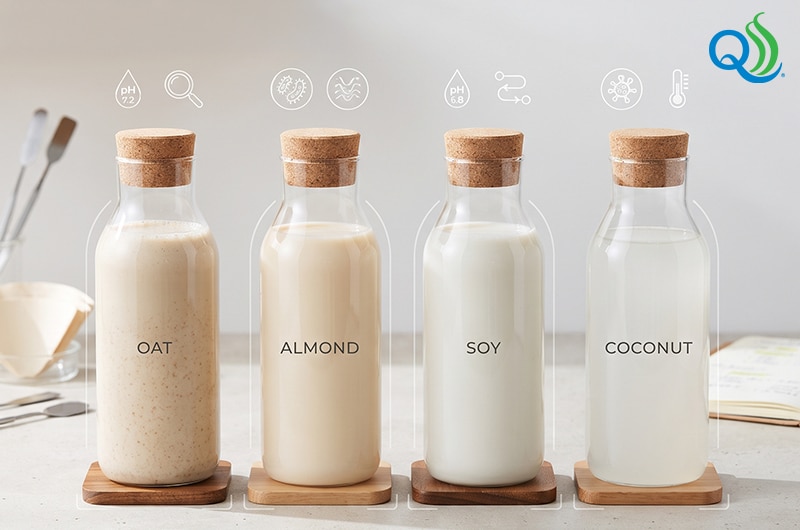
Navigating Quality Assurance Complexity in Plant-Based Beverages: Why the Dairy Playbook Falls Short
Plant-based beverage Quality Assurance (QA) is becoming more complex as oat, almond, soy, coconut, and blended functional formats mature from niche products into mainstream dairy substitutes with expectations for high quality and shelf stability.The QA infrastructure supporting plant-based beverages has often drawn on frameworks developed for conventional dairy microbiology. That borrowing creates real diagnostic risk, however, because the chemistry and microbial ecology of a plant-based matrix is unique and not simply dairy ecology with a different label. In fact, plant-based beverages are distinct and complex formulations governed by different compositions, different regulatory requirements, and different failure modes. Getting the diagnosis right starts with accepting that complexity rather than defaulting to familiar frameworks.
This blog accompanies QualiTru’s Plant-Based Beverage Spoilage Guide to help explain why understanding the unique microbiology of each beverage matrix is essential for accurate troubleshooting and to keep quality assurance teams from diverting down the wrong investigative path.
Why Plant-Based Beverage QA Requires a Different Playbook
Plant-based beverages may resemble dairy products on the shelf, but they behave very differently during processing and spoilage. Their unique formulations, ingredient interactions, and regulatory requirements mean QA teams cannot rely solely on traditional dairy troubleshooting methods. Before investigating microbial risks, it’s important to understand why these products require a different QA approach.
Unlike conventional fluid milk, which is governed by prescriptive time-temperature minimums under the Food and Drug Administration’s (FDA) Grade “A” Pasteurized Milk Ordinance (PMO), no commodity-specific federal regulation specifies minimum heat treatment parameters for plant-based beverages. Instead, the applicable framework is determined by equilibrium pH and water activity (Aw) across three tiers.
Refrigerated plant-based beverages fall under 21 Code of Federal Regulations (CFR) Part 117 of the Food Safety Modernization Act (FSMA), which requires processor-validated heat treatment but imposes no prescriptive thermal minimum. Non-refrigerated shelf-stable plant-based beverages with pH above 4.6 and Aw at or above 0.85 are classified as low-acid canned foods under 21 CFR Part 113, requiring commercial sterility equivalent to a minimum 12D reduction of Clostridium botulinum spores and a process established by a qualified process authority. Plant-based beverages acidified to pH at or below 4.6 fall under 21 CFR Part 114, where pH management is the operative food safety control. Voluntary schemes, such as
Food Safety System Certification (FSSC) 22000, International Organization for Standardization (ISO) 22000:2018, Safe Quality Food (SQF), and British Retail Consortium Global Standards (BRCGS), overlay Hazard Analysis and Critical Control Points (HACCP)-based obligations and are effectively mandatory in retail supply chains. All parameters must be validated per individual product matrix and process configuration (QualiTru Sampling Systems, 2026).
That last sentence is what carries real weight. The process that protects one plant-based beverage format does not automatically protect another. Thermal process class, whether high- temperature short-time (HTST), extended shelf-life (ESL), ultra-high temperature (UHT), or acidified, defines the residual microbial ecology, and that ecology determines which organisms you are actually chasing.
The Same Defect, Different Causes
Consider souring. Across all plant-based beverage formats, souring is most commonly driven by lactic acid bacteria (LAB). The first diagnostic move is consistent: confirm by pH drop versus a retained sample, paired with elevated LAB counts. Flavor change without pH or count movement is not LAB souring. That distinction is important because plant-based matrices generate off-notes through multiple non-microbial pathways, such as lipoxygenase activity in soy producing beany or grassy notes, or lipid oxidation in almond generating rancidity that reads as sourness or astringency. Chasing a microbial cause for a chemistry problem wastes time and misses the actual driver .
Soy is worth flagging on two counts. From a safety standpoint, soymilk is a well-characterized growth matrix for Listeria monocytogenes due to its neutral pH and rich nutrient profile (Bartula et al., 2023). A documented illness or temperature abuse history in soy products should trigger a food-safety pathway, not a routine spoilage investigation. From a spoilage standpoint, soy is among the fastest-spoiling plant-based beverage formats after post-heat contamination. Any positive LAB signal should be treated with urgency, given the short window from contamination to detectable defect.
Coconut presents different complications. Acidified or juice-blended coconut beverages introduce the possibility of Alicyclobacillus spp., a flat-sour pattern with guaiacol off-odor that is distinct from LAB souring and will be missed entirely by standard LAB enumeration. Confirmation requires selective media and awareness that the flat-sour pattern develops only under both acid and warm storage conditions. This is not an organism that would typically appear in plant QA programs inherited from dairy, but in this case, it is a vital addition.
Don’t assume similar defects share the same root cause. Confirm the organism before choosing corrective actions.
Companion Resource: Plant-Based Beverage Spoilage Guide
Download our FREE Plant-Based Beverages Spoilage guide for a quick-reference troubleshooting chart that summarizes common spoilage patterns, likely microorganism groups, and product-specific considerations for oat, almond, soy, coconut, and blended beverages.
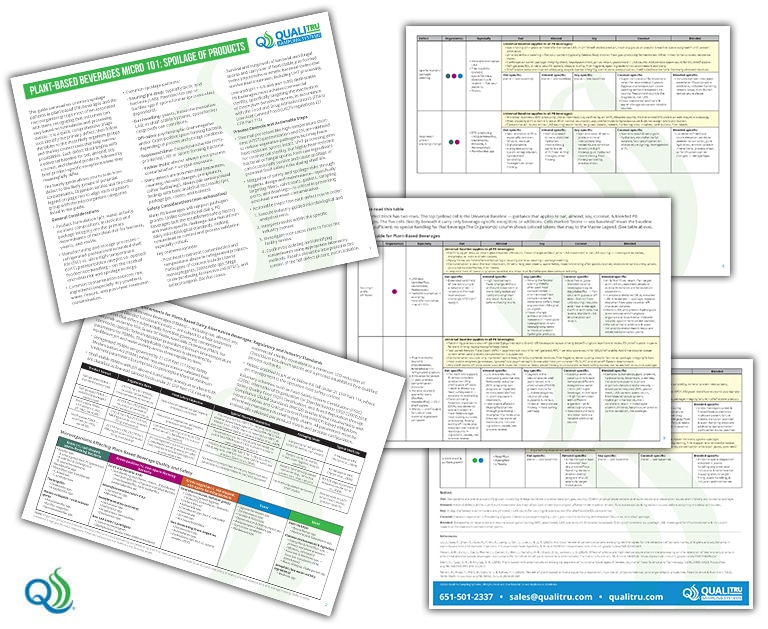
Complete the form below to download the Plant-Based Beverage Spoilage Guide.
Viscosity and Separation: Resist the Micro Attribution
Viscosity drift and phase separation are among the most commonly misattributed defects in plant-based beverage QA. The impulse to look for a microbial cause is understandable since these defects are visible, affect consumer perception, and can signal spoilage. In plant-based beverage systems, however, they are most often physical rather than microbial.
In oat beverages, residual β-glucanase and α-amylase activity, starch retrogradation, hydrocolloid variability, and homogenizer shear history are the dominant drivers of viscosity change. In soy, protein-mineral interactions — particularly sensitivity to calcium and pH history — drive both viscosity and separation. In coconut, fat coalescence during cold storage or temperature cycling generates separation that is frequently mistaken for emulsion failure with a microbial component (Lim and Baik, 2025).
Microbial attribution for ropiness or viscosity change requires three confirming signals simultaneously: pH shift, elevated counts, and strand-forming exopolysaccharides (EPS) visible on wet-mount microscopy. Without all three, the assumption should be formulation or process cause. This is not only a conservative position to take but an accurate one.
Separation alone is not evidence of microbial spoilage.
Gas, Swelling, and the Shelf-Stable Red Line
Gas formation with falling pH points to yeast or heterofermentative LAB in refrigerated and ESL formats. In UHT or shelf-stable product, any gas development should be treated as an aseptic breach or spore outgrowth until proven otherwise. Paenibacillus spp. and other organisms have been shown to proliferate more rapidly in plant-based matrices than in bovine milk under temperature-abuse conditions (Bartula et al., 2023). That alone is reason enough to escalate any shelf-stable gas event immediately rather than work it as routine spoilage.
The flat-sour pattern of pH drop without swelling implicates thermophilic Gram-positive spore-formers, particularly Geobacillus spp. Root causes may include hot-process residence times and equipment failures, such as cracked heat transfer plates that harbor biofilm. Either way, it requires a different investigation pathway than gas-producing fermentation. Confusing the two leads to the wrong corrective action.
Sugar-rich coconut formulations introduce an additional variable: osmotolerant yeasts. Zygosaccharomycesspp., in particular, can drive swelling without elevated LAB counts. The diagnostic here is yeast/mold count, not LAB. This distinction only becomes obvious if the test panel is matched to the product matrix.
Always interpret swelling within the context of process class.
Pair Every Finding With Analytical Data
The common thread across all of this is discipline in attribution. Many plant-based beverage defects are non-microbial. Separation, creaming, viscosity changes, precipitation, and coffee feathering in barista formats are predominantly physical phenomena. Microbial attribution requires a confirming signal: pH shift versus retained samples, off-odor, gas or swelling, or elevated counts appropriate to the process class. Without that signal, the investigation belongs in formulation or process engineering, not microbiology.
Almond-based products present a particular version of this challenge. Thermal parameters for HTST processing of almond-based beverages have been studied at 94–116°C for 30 seconds (Redan et al., 2024), yet lipid oxidation, not microbial activity, remains the primary driver of off-notes in the absence of pH or count deviations. The same matrix that requires careful thermal validation for pathogen reduction generates its most common sensory defects through chemistry, not microbiology. That duality is what makes plant-based QA genuinely difficult, and why no single framework borrowed wholesale from dairy will cover it.
This is the core discipline that plant-based beverage QA frameworks must build explicitly. The matrices are different. The failure modes are different. The organisms are different. A QA program that treats plant-based beverages as dairy-adjacent rather than chemically distinct will consistently misdiagnose the easy cases and miss the dangerous ones.
Representative Sampling Improves Root Cause Investigations
Analytical results are only as reliable as the samples collected. When investigating spoilage in plant-based beverages, representative sampling of incoming ingredients, post-heat treatment products, and critical transfer points can provide a much clearer picture of where contamination enters the process.
Relying solely on finished product testing often identifies contamination only after quality has already been compromised. Representative in-process sampling helps quality teams narrow potential contamination pathways, improve root cause investigations, and make corrective actions more targeted and effective.
Better Decisions Start with Better Understanding
Effective plant-based beverage QA starts with understanding how formulation, processing conditions, microbiology, and chemistry interact to shape product quality. Understanding those interactions is the first step toward faster root cause investigations, more effective contamination control, and more predictable shelf-life performance.
Download our Plant-Based Beverage Spoilage Guide for a practical reference to common spoilage organisms, likely contamination sources, and troubleshooting considerations across oat, almond, soy, coconut, blended, and other plant-based beverages.
If you’re investigating unexplained plant-based beverage spoilage, our team is here to help. Contact us at (651) 501-2337 or submit your question through QualiTru’s Ask the Experts form to connect with a QualiTru team member to discuss your specific challenges.
References:

Bartula, K., Begley, M., Latour, N., & Callanan, M. (2023). Growth of food-borne pathogens Listeria and Salmonella and spore-forming Paenibacillus and Bacillus in commercial plant-based milk alternatives. Food Microbiology, 109, Article 104143. https://doi.org/10.1016/j.fm.2022.104143

Karimi, Z., Campbell, K., Kevei, Z., Patriarca, A., & Anastasiadi, M. (2025). A critical review of conventional and emerging technologies for the detection of contaminants, allergens and adulterants in plant-based milk alternatives. Current Research in Food Science, 10, 101067. https://pmc.ncbi.nlm.nih.gov/articles/PMC12141547/

Lim, H.-S., & Baik, M.-Y. (2025). Emulsifiers for the plant-based milk alternatives: a review. Food Science and Biotechnology, 34(2), 515–525. https://doi.org/10.1007/s10068-024-01814-7

Redan, B. W., Zulic, J., Cai, J., Warren, J., Carter, C., Wan, J., Sandhu, A. K., Black, D. G., & Jackson, L. S. (2024). Effect of pilot-scale high-temperature short-time processing on the retention of key micronutrients in a fortified almond-based beverage: Implications for fortification of plant-based milk alternatives. Frontiers in Nutrition, 11, Article 1468828. https://pmc.ncbi.nlm.nih.gov/articles/PMC11459625/

Sethi, S., Tyagi, S. K., & Anurag, R. K. (2016). Plant-based milk alternatives an emerging segment of functional beverages: A review. Journal of Food Science and Technology, 53(9), 3408–3423. https://doi.org/10.1007/s13197-016-2328-3